
Fields in Lawrence County Property Tax Records
Lawrence County splits its tax information between two functions. One side appraises the property. The other collects the bill. Read every number with its tax year and its status attached.
| Tax field | Meaning | Source |
|---|---|---|
| Appraised value | Administrative estimate before classification | AssuranceWeb |
| Land/improvements | Separate appraisal components | Assessment record |
| Assessed value | Class-adjusted tax base | Assessment record |
| Exemption/current use | Relief recorded for the account | Revenue/Appraisal |
| District and tax due | Jurisdiction and billed amount | Tax record |
| Paid status/receipt | Payment record for a selected year | Avalon |
Appraised, assessed, taxable, and amount due may look like synonyms, but each plays a distinct role in a Lawrence County tax record. A tax value, in short, is not automatically a sale value.
Search Lawrence Assessments in AssuranceWeb
The AssuranceWeb search handles queries by Name, PIN, Company, Parcel, Account, Subdivision, and Address, with a tax-year selector built in.
| Entry | Best use | Verify |
|---|---|---|
| Address | Known situs | Legal description and PIN |
| Name/Company | Owner-linked accounts | Trust or entity wording |
| PIN/Parcel | Cross-system match | Format and year |
| Account | Known revenue account | Billing identity |
| Subdivision | Development browse | Lot description |
Note the displayed year before you rely on anything. An older roll can legitimately show a different owner of record or value.
Avalon Preserves Lawrence Payment History
The older Avalon portal provides controls for tax year, paid and unpaid status, property type, search-by, and search text. Treat it as a supporting route for payment and receipt detail. Do not treat it as the current source of truth. Its available-year response has shown 2020 alongside a placeholder value. So ages of the data deserve a second look.
The portal's own interface displays the distinct Lawrence County property tax controls.
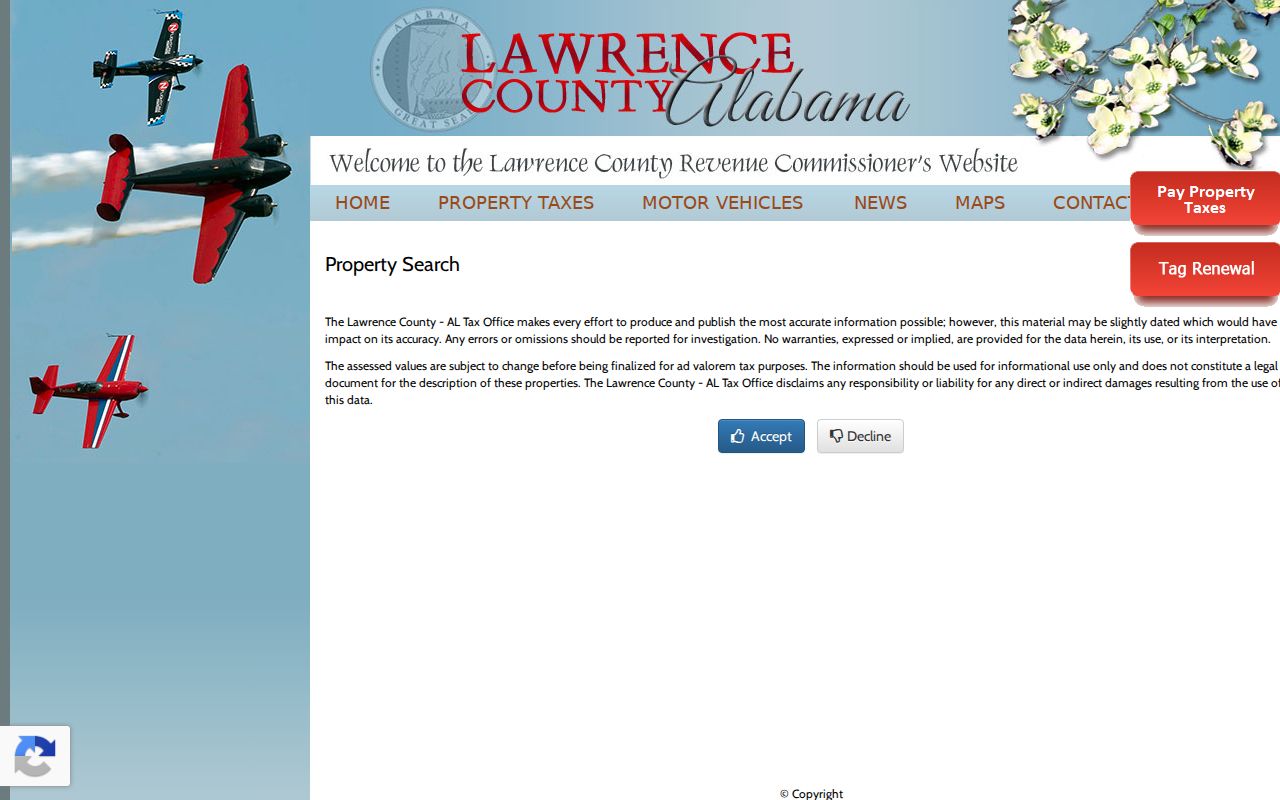
Cross-check its parcel, account, status, and year against AssuranceWeb, and ask Revenue to reconcile any differences.
Look Up a Lawrence County Tax Bill
- Find the parcel and account in AssuranceWeb by address, PIN, or parcel.
- Open the same account and year in the payment search.
- Record amount, status, and receipt rather than inferring payment from a balance.
- Review classification, exemptions, and current-use fields.
- Ask Revenue about unexplained delinquency or corrections.
Tax terms
- Assessed value
- Appraised value after Alabama's class ratio.
- Levy
- The adopted tax applied to taxable assessed value.
- Homestead exemption
- Qualifying relief that must be reflected on the account.
- Tax lien
- A statutory claim for unpaid property taxes.
Alabama Classes Shape Lawrence Assessments
ALDOR guidance sets four ratios. Class I utility property is assessed at 30 percent. Class II sits at 20 percent, and Class IV private passenger automobiles at 15 percent. Class III covers agricultural, forest, residential, and historic property at 10 percent.
Classification and exemptions come before any bill comparison. A rural-looking GIS polygon does not establish agricultural classification. A mailing address does not prove eligibility either.
Equalization Reappraises Lawrence in Stages
ALDOR describes annual equalization as a rotating review of roughly one quarter of a county each year. Every parcel is reappraised over four years. A value can shift without any deed changing hands.
Gather the notice, the tax year, photographs, property facts, and comparable information that matters to you. Keep the comparable data close at hand. Construction, corrections, classification, exemptions, and equalization can each move a record.
Note: A changed Lawrence assessment does not, by itself, prove a recent sale.
The Seven-Percent Cap Is Not Market Value
ALDOR's Act 2024-344 guidance explains a 7 percent annual cap on qualifying Class II and III taxable real property, with exceptions tied to ownership and use. The cap limits certain taxable-value growth. It is not a market-value ceiling. It is also no promise of an unchanged bill.
Classification changes, exemptions, levy shifts, additions, corrections, and ownership or use events can all alter the outcome. Read the complete Lawrence County tax record instead of simply adding seven percent to last year's bill.
Verify Lawrence Exemptions with Revenue
Never infer exemption status from an apparently occupied house. Never infer it from a mailing address, the age of a dwelling, or the previous owner's record either. Ask Revenue which application and evidence apply. Ask whether relief shows for the year you selected.
The Alabama Department of Revenue directory lists Lawrence Revenue at 256-974-2473 and Appraisal at 256-974-2457. Those numbers reach the right desks for classifications, mapping, exemptions, and assessment cards.
Protest a Lawrence County Assessment
ALDOR guidance directs an owner to file a written Board of Equalization protest within 30 calendar days of the valuation notice. Alabama Code §40-2-18 governs objections and hearings. Follow the instructions printed on the actual notice.
- Preserve the notice and delivery date.
- Identify parcel, year, classification, and disputed value.
- State the requested correction with property-specific evidence.
- File as directed and retain proof of timely delivery.
- Keep the board decision separate from later appeal rights.
Appeal window. State guidance uses 30 calendar days from notice; verify the notice-specific deadline and delivery method before filing.
Tax Sale Requires More Than an Unpaid Flag
A portal flag showing "unpaid" is only a starting point in Lawrence County. It is not a sale notice, and it is not a title opinion. Call the Revenue office for the current delinquency status and any scheduled sale. ALDOR's tax-sale guidance covers state-held certificates and tax deeds. It warns plainly: the process does not guarantee clear title.
Dig into redemption rights, earlier encumbrances, pending litigation, and anything already recorded. A tax record can never substitute for the full deed chain.
Four words get confused constantly: delinquent bill, lien, certificate, and tax deed. They mark different stages of the same process. The interest holder named on one may not match another. Check Probate for later instruments and Circuit Court for related lawsuits. State sheriff-sale guidance also flags redemption periods and prior encumbrances. Treat any sale list as a lead rather than a clean-title inventory.
A solid Lawrence County property tax file stays organized. Keep the notice year, appraised and assessed values, classification, exemption or current-use status, district, and amount due in one place. Keep the receipt and appeal papers there too. Guard the PIN and the formatted parcel number carefully. Without them, a bill can attach to a similarly named owner or an adjacent tract. When acreage, improvements, or legal descriptions conflict, ask Mapping and Appraisal to sort it out.
Verify tax districts and municipal names before assuming anything. A Moulton, Town Creek, or Courtland mailing address proves nothing about incorporation or a city levy. GIS city fields, situs text, and tax district codes are only clues. Where a boundary changes the tax bill, get the county map. Get the municipal annexation record too, instead of inferring jurisdiction from an envelope.
Rural Lawrence County raises current-use and timber questions that turn on specific facts. Record the timber acreage, the tax fields, land and improvement values, classification, exemptions, and the tax year. Then ask Revenue how the account was actually treated. Fields that look agricultural from the air may not carry agricultural classification. Likewise, a mobile-home description does not settle whether the improvement is real property, personal property, or separately assessed.
An appeal lives or dies on matching evidence to the disputed fact. Photographs speak to condition. A survey addresses acreage. A permit establishes the timeline of work, and comparable sales speak to market value. None of these proves the others. Label the parcel number on every attachment. Keep proof of delivery. And never assume an informal staff review extends a formal filing deadline.
After a conveyance, Lawrence systems update on different clocks. Probate may show the new grantee before the assessment roll refreshes. GIS and payment records may lag further still. Compare the newest deed against the tax year and the date you observed each record. The deed documents the recorded transfer; Revenue keeps the tax account.
When portals fall short, give Revenue or Appraisal the address, the displayed owner, the PIN, parcel, and account. Include the tax year as well. Say whether the question concerns appraisal, classification, exemption, current use, billing, payment, delinquency, or mapping. That routing gets the file to the right desk. For anything in writing, name the specific assessment card, receipt, or notice and request a copy estimate.
Keep permit and infrastructure context out of your tax-value reasoning. A municipal permit valuation reflects the applicant's project figure, not the assessor's market estimate. The 2025 Town Creek sewer grant supplies useful infrastructure context. It supports no conclusion about any single parcel's price. Each record documents only the fact it was created to document.
After a correction or an appeal, save both versions. Note the effective year, the office action, and whether the payment system has caught up yet. That chronology keeps later Lawrence County property records research reproducible. It also stops a corrected assessment from being mistaken for a payment, a refund, or a change in recorded ownership.
Keep the official receipt for proof of payment. A search-result screen is not the same thing. Match the receipt's account, parcel, year, amount, and posting date against the bill. If a payment is missing or applied oddly, contact Revenue with the receipt details. Keep the response on file. That paper trail beats rerunning a portal query. Its interface or available years may change at any time.