
Reconstruct Lawrence County Former Owners
Work backward one transfer at a time from the present parcel card. GIS fields for PreviousOwner and DeedBook/DeedPage give immediate leads. Probate deeds then establish each grantor and grantee pair. From there, historic indexes, deed books, plats, tax records, and archives carry the ownership chain into earlier eras of Lawrence County history.
| Source | Years It Covers | Where Held | What It Shows |
|---|---|---|---|
| Probate/ING land records | Cutoff not posted | Online vendor route or Probate | Recorded grantor, grantee, and deed |
| General/direct/reverse index | 1818-1903 | Microfilm and repositories | Name route into older books |
| Deed books | 1822-1902 | 16 FamilySearch-listed reels | Earlier conveyance text |
| Pre-1920 county records | Collection dependent | Lawrence County Archives | Indexes, abstracts, and local copies |
The county publishes no posted cutoff for its online land index. Start from the current deed reference, then ask Probate how far back the online index reaches. A historical finding aid from the state archives offers another documented route for nineteenth-century parcel and deed research.
Read Lawrence's Reverse Deed Index
A direct index opens with the grantor. A reverse index opens with the grantee instead. Backward research leans on the reverse route. The current deed names the prior owner as grantor, so the next job is finding when that same person took the tract as grantee. FamilySearch's catalog can help here.
It lists a general index, a direct index, and a reverse index for Lawrence County, with index coverage from 1818 through 1903 and deeds from 1822 through 1902 across 16 reels. Those dates describe cataloged historic material only. They do not promise that current courthouse images sit freely online.
See the Lawrence Probate Route
Open the Lawrence Probate/ING portal before reviewing the captured land-record landing page.
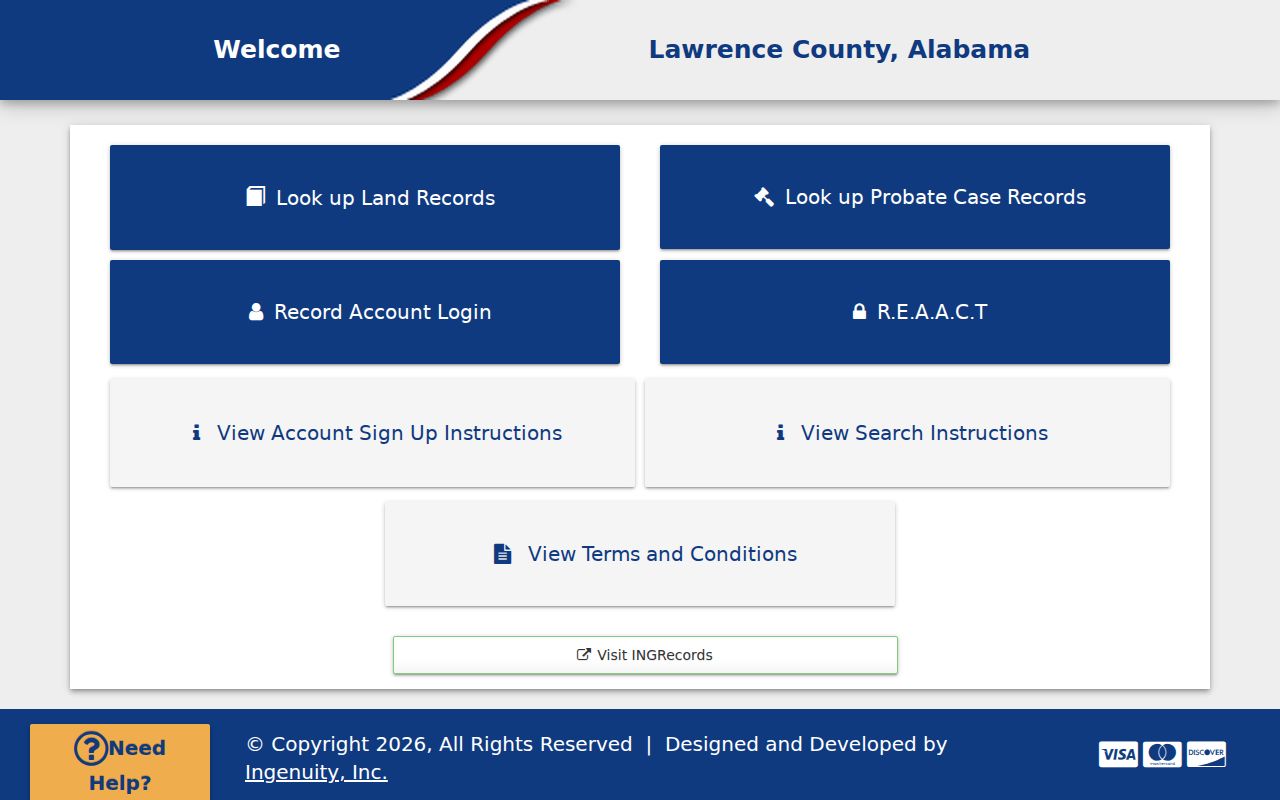
The Lawrence Probate portal leads researchers toward recorded papers, though account, payment, completeness, and anti-automation terms still govern any online access.
Walk Lawrence Deeds Backward
Build a timeline with one row per conveyance. Even a clean-looking name sequence needs the same legal description, or a supported parcel transition, before it proves that ownership actually changed hands in Lawrence County.
| Transfer Date | Grantor to Grantee | Deed Type | Book/Page |
|---|---|---|---|
| Newest recorded date | Prior owner to current grantee | As indexed | Current parcel reference |
| Earlier recorded date | Earlier owner to later grantor | As indexed | Prior acquiring deed |
| Repeat backward | One supported link at a time | Preserve exact label | Historic book reference |
- Find the current owner's acquiring deed and verify the parcel description.
- Record its grantor, grantee, deed type, recording date, and book/page.
- Search the grantor as grantee to locate that former owner's acquiring deed.
- Repeat while checking name variants, spouses, representatives, trusts, and companies.
- At the online limit, continue through the reverse index, deed books, Probate, or Archives.
- Grantor
- The party conveying an interest.
- Grantee
- The party receiving it.
- Chain of title
- The ordered sequence of instruments affecting ownership.
- Reverse index
- An index organized by grantee for tracing acquisitions.
- Quitclaim deed
- A conveyance of whatever interest the grantor has, unlike warranty language that carries stated title promises.
Bridge Old Lawrence Legal Descriptions
Older deeds speak in section, township, range, metes and bounds, or subdivision lot and block rather than modern street addresses. Copy the wording exactly. Compare adjoining owners, roads, acreage, plats, and later deed references. Only then call two descriptions the same tract.
Parcel splits, mergers, and retired identifiers can break a simple number search in Lawrence County. Mapping/Appraisal can review a GIS mismatch. Probate holds the recorded deed and plat. A modern parcel polygon helps bridge the gap, though an old deed line may not follow today's tax-map edge.
Lawrence Archives as a Fallback
Lawrence County Archives keeps public records from before 1920, with record groups covering the tax assessor, tax collector, probate, court, commission, sheriff, education, and voter files. It does not lend original records. When an online land image is gated or incomplete, the Archives' mail-copy workflow is a documented fallback.
Give the Archives an exact book and page when you can, and keep a copy request separate from staff research. The cited workflow lists a $10 book search plus $1 per page, but confirm current terms before sending payment. The Archives sits at 698 Main Street in Moulton and lists 256-974-1757. Its pages show variant staff-name and email spellings, so verify the active contact.
County originals and Alabama Department of Archives and History holdings can extend the microfilm trail. Save the FamilySearch film number whenever one appears, such as examples 1686107, 1711064, and 1711066 in the catalog. A film citation makes a follow-up request far more precise than asking staff to trace every former owner of record who shares a common surname.
Breaks in Lawrence Deed Chains
A Lawrence County deed chain can stop cold. Probate is one cause. So are court orders. So are transfers by a spouse, deeds signed by a representative, and conveyances to an entity. Try the name in both grantor and grantee columns. Add initials and spelling variants, then inspect nearby mortgage and release references for clues.
A quiet-title suit, partition, foreclosure, or estate file can explain why ownership changed hands. None of them replaces a recorded conveyance. The Circuit Clerk needs a case type, party names, a date or case number, and the parcel legal description. A court link cannot be pulled before that. Probate wants the estate name, filing date, case number if known, and the same land identifiers. Request only public papers that matter. Keep the court event off the deed timeline until the records support the connection.
Archives Errors Affect Former Owners
Archive errors can hide former owners. The local archive warns that Marriage Book A survives only in part. It also flags a WPA abstract of Book C as containing errors. Names appear as written in the source. That matters whenever a marriage, an inheritance, or a spouse's name explains a chain.
Search spelling variants across everything. Note whether each result came from an original, an abstract, or a transcription. Note the same for a donated file or a database index. Marriage and death records can support identity and chronology. They cannot transfer land; only a deed or a court-authorized conveyance supplies the chain link.
Estate transfers need extra care. Confirm that a personal representative held authority on the conveyance date. Also confirm that the deed or order was recorded. Mortgages, releases, liens, and easements explain why a deed chain is not the whole property story. Log them as separate instruments rather than owner changes.
Depth of Lawrence Ownership Records
The historical catalog takes Lawrence County deed books back to 1822, and the county index spans 1818 through 1903. For older patents and grants, the Alabama Secretary of State land records reach from statehood to 1950. They can be searched by name, township, range, section, or book. Those state files help with patents and grants, not county deeds. For anything after 1950, probate is the county route. A chain can still pause at an estate. It can also pause at a name change, an unindexed instrument, a changed legal description, or a missing image. When that happens, mark the gap instead of forcing a match. For a current deed copy or detailed deed mechanics, the Lawrence County deed records resource is the right stop.
Tax rolls can bridge two deeds in a Lawrence County ownership timeline, especially when the same owner name appears year after year. A tax entry is still not a conveyance. A plat works the same way. It can establish the lot scheme without naming any later owner of record. Treat both as supporting records. Keep every ownership link tied to an instrument that actually affects title, such as a deed, patent, or court-authorized transfer.
Some former owners hide behind a spouse's name, an estate, a corporation, or a trust. Search the direct and reverse indexes with initials, alternate spellings, and role terms. Preserve the index spelling even when it looks wrong. Then compare the legal description and the adjoining tracts before accepting the match. The Archives warning about abstract errors makes that second check matter.
Separate execution from recording in any historic chain. A deed may have been signed on one date and entered in the public books much later. Record both dates when available. Probate filings and death certificates carry their own dates too. Keeping these events apart stops a later recording date from being mistaken for the day ownership changed.
Finish the backward table with a source citation for every row. A book and page is one option. So is an instrument number, a film number, an archive collection, or a patent reference, and any of them lets another researcher repeat the work. Mark any inferred link as unresolved until the parties and the description both match. That caution matters most when the same surname appears on nearby tracts or a subdivision lot replaced an acreage description. Keep a separate list of instruments that touch the land without changing the named owner. Mortgages, releases, liens, easements, plats, and road records all explain a property's history, yet none belongs in the chain unless it truly conveys an interest.
Lawful use. Former-owner research supports house history, estate work, and title diligence. Never use past-owner records to track, harass, or harm a living person.